Colour Mixing Essentials for Acrylics and Gouache
Start with intention: a limited palette
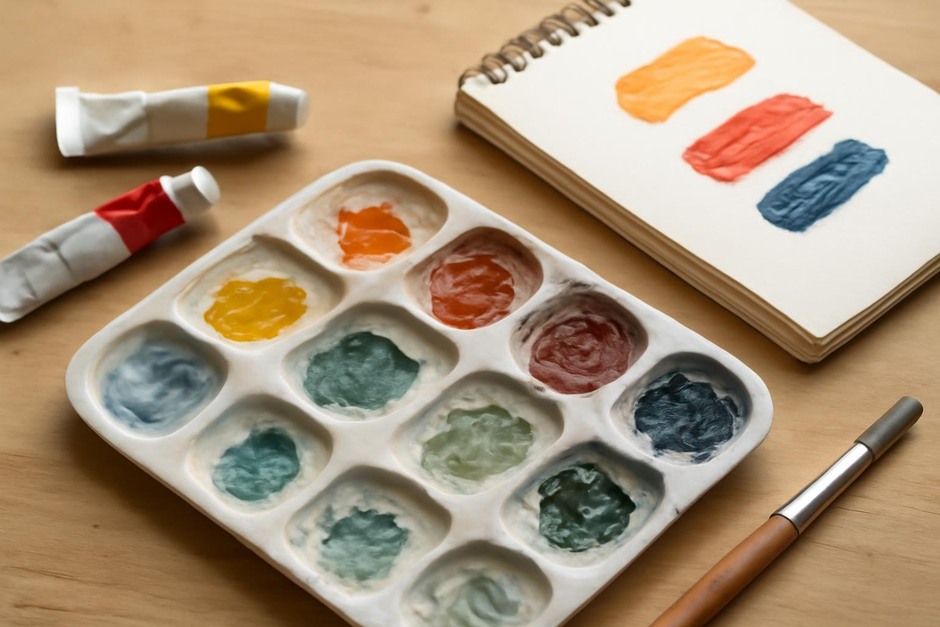
Using a limited palette simplifies decisions and helps you learn the behaviour of pigments. Choose three primaries—one warm and one cool for each colour family—plus white and maybe a neutral pigment. For example, a warm red, a cool red, a warm yellow, a cool yellow, and a cool blue often provide enough variety to mix a broad range of hues.
Understand temperature and bias
Each pigment has a temperature bias. A cool red mixed with a warm yellow yields an orange that leans one way; reversing the yellow shifts the result. Knowing these biases helps you predict mixtures and avoid surprising dulled greys. Spend time mixing the same target colour using different combinations to see how bias affects the outcome.
Mixing neutrals and grays
Neutral or subdued colours emerge naturally from mixing complements—colours opposite each other on a simple colour wheel. However, true neutrals are often better achieved by combining a small amount of a cool pigment with a warm counterpart rather than overpowering complements. For consistent neutrals, reduce chroma gradually and observe how a single addition of a cool blue or warm brown alters temperature.
Value before hue
When mixing for a painting, establish values first. A colour of the correct value but slightly off in hue will hold structure better than a perfect hue at the wrong value. Make small value sketches using a monochrome mixture to confirm light and dark relationships before committing to full colour.
Practice exercises
- Limited gradient study: Choose one warm and one cool primary and mix a series of steps between them to observe hue shifts and chroma changes.
- Three-colour harmony: Pick three primaries and mix triads of secondary colours, noting how each primary contributes to the mixture.
- Match-the-swatch: Create swatches and attempt to match a printed or observed colour using only three pigments. This sharpens observation and mixing control.
Working with acrylics and gouache
Acrylics dry darker and can be slightly glossier; adjust values to compensate. Mixed acrylic colours may need lighter tints when dry. Gouache behaves more like opaque watercolor and can be reactivated with water; it tends to dry flat and matte. Both mediums respond well to scumbled layers for subtle chromatic effects, but remember that drying alters appearance.
Record and reuse mixtures
Keep a colour journal with swatches and notes about ratios. A small notation like “2:1 yellow to blue” helps you reproduce a useful mix later. Over time, this journal becomes an invaluable reference library tailored to your pigments.
Limitations and acceptance
Some colours are difficult to mix precisely from primaries. Certain bright pigments and modern formulations may be unique. Accepting limitations is part of the practice: when a particular hue is essential, keep a tube of that pigment. The skill lies in knowing when a mix is acceptable and when to use a direct pigment.
Colour mixing becomes less mysterious with deliberate exercises, a compact palette, and regular recording of results. Slow experiments build intuition: the mixtures you can predict reliably become the palette you trust in finished work.